
BREW GUIDE

How to brew the Heirloom Collection.

Each of these offerings represent my partnership with a local couple importing directly to Minnesota from their native Ethiopia.
RESERVE YOUR COFFEE

We designed this Collection as a demonstration of how coffee grown throughout Ethiopia can taste different. It all depends on the soil and microclimate. This is an opportunity to compare two of the most famous origins in Ethiopia.

'Processing method' makes a difference, too!

'Washed process' and 'natural process' represent the extremes of 'processing' in most available specialty coffees.

Can we use that information as we decide how to brew it?

Yes.

FILTER

POUROVER | DRIP

WATER TEMPERATURE

Brew the washed process Guji Raro with water just off boil, around 205°F. Reduce the temperature for natural Worka Chelbesa, perhaps 195-200°F.

Hot water works to transform flavor compounds in the coffee. Those compounds, including Chlorogenic Acids, are also broken down as coffee is processed and roasted.

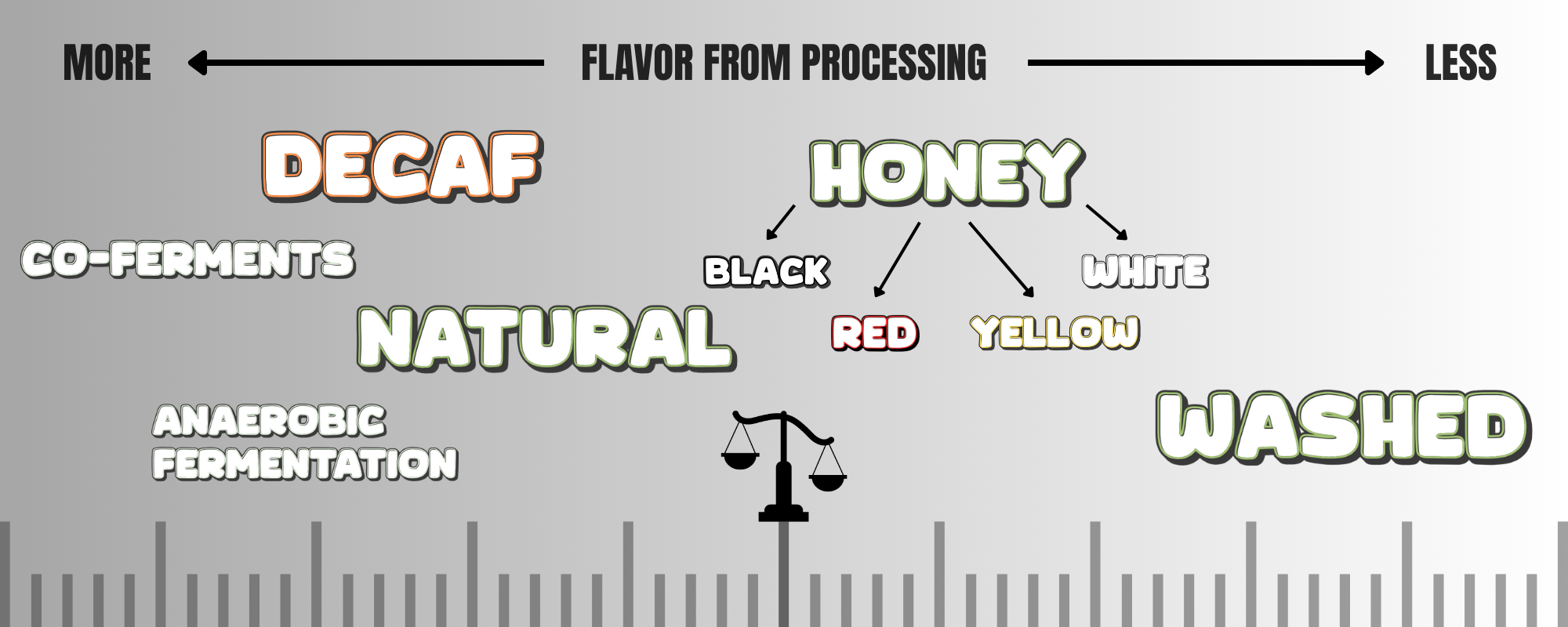
You can use the scale below to choose a starting temperature for any coffee.

If a coffee is heavily 'processed' prior to brewing, a lower temperature is required to release our desired flavors. This includes decaffeination processes!

The left end of this scale calls for water at 190-195°F; ranging all the way up to 205°+ for washed coffees.
GRIND SIZE

Ethiopia tends to produce small and dense coffee. The dense structure makes it more difficult for water to extract flavor compounds from the grounds. To combat this, grind a little bit finer than your usual recipe. More surface area, accomplished by grinding finer, accommodates more extraction.

You will find that the Guji beans are more dense than the produce of Worka Chelbesa.

Depending on your brewing device, start anywhere from medium to medium-coarse and keep getting finer until you taste astringency, or unpleasant acidity. The goal is to get as fine as possible.

This is also your mechanism to manipulate brew time. No matter the coffee, it's usually safe to stay between 3 and 4 minutes from first pour to last drop.

Single-cup devices, like a Hario v60, benefit from a finer grind to extend the brew time. Larger devices, like the Chemex, require a coarser grind to reduce contact time with the coffee bed.

Medium-fine: Baratza Encore 8-15, Timemore 14-19, Fellow Ode 3-5
Medium: Baratza Encore 15-22, Timemore 19-26, Fellow Ode 5-6
Medium-coarse: Baratza Encore 23-28, Timemore 27-32, Fellow Ode 7-8

ESPRESSO

Ethiopian coffees have a reputation for sourness in espresso settings. It all comes back to density once again! After a while, you'll probably start to get an eye for which coffees are more dense while weighing them.

Don't worry too much about grind size to start. Use your usual starting point (a bit finer than table salt).

The key to the natural Worka Chelbesa will be your ratio - lengthen it! I'm talking start at 1:2.5 and go up from there.

At a 1:2.5+ ratio you can go beyond 30 seconds for the shot. Any longer than this, or if you're still tasting sourness, try grinding a little bit coarser to speed up the brew.

Try this same method for the washed Guji. Start at 1:2 and see how close to 1:3 you can get before you start to lose body. The result may surprise you!

GENERAL TIPS

ONE STEP AT A TIME

Remember high school science class? The Scientific Method and all that?

Well, these are our variables:

WATER TEMPERATURE
GRIND SIZE
BREW TIME

And we only want to change one at a time to create the best experiment.